

The Constitutional Legitimacy of H.R.H. Prince Antoine V of Araucania and Patagonia
Ninth Sovereign of the Kingdom of Araucania and Patagonia and Head of the Royal House since 12 May 2025.
H.R.H. Prince Antoine V of Araucania and Patagonia is the Ninth Sovereign of the Kingdom of Araucania and Patagonia and Head of the Royal House since 12 May 2025.
His accession followed the abdication of Prince Frederic I on 16 February 2025 and the subsequent institutional succession process culminating in his election on 12 May 2025.
The constitutional position of Prince Antoine V is based on the historical constitutional tradition of the Kingdom, established by King Orélie-Antoine I on 17 November 1860 and subsequently developed through the Additional Act to the Constitution promulgated by Prince Antoine IV on 18 August 2016.
These constitutional instruments provide the framework governing the Crown, the elective principle of succession, the Regency, the selection of a Sovereign and the constitutional oath.
The Royal House of Araucania and Patagonia recognises Prince Antoine V as its Ninth Sovereign following the institutional succession process of 2025.
This page presents the historical foundations, constitutional provisions and institutional interpretation underlying his accession.
I. The Historical Foundations of the Kingdom of Araucania and Patagonia
The Kingdom of Araucania and Patagonia traces its constitutional origins to King Orélie-Antoine I, born Orélie-Antoine de Tounens, who established the monarchy in the nineteenth century.
On 17 November 1860, King Orélie-Antoine I promulgated the founding constitutional texts establishing a constitutional and hereditary monarchy and defining its principal institutions.
The original constitutional framework provided for:
- A King or Queen according to the hereditary order established in the founding Constitution.
- Ministers responsible to the Crown.
- A Council of the Kingdom.
- A Council of State.
- A Legislative Body.
The Constitution established the institutional responsibilities of the Crown and defined the respective functions of the Kingdom's principal bodies.
Article 3 identified the King as Head of State and established the principal sovereign responsibilities. Article 5 provided for the sanction and promulgation of laws by the King.
Articles 21 to 25 defined the constitutional role of the Council of the Kingdom.
In particular, Article 23 entrusted the Council with regulating matters not expressly provided for in the Constitution and interpreting constitutional provisions giving rise to different interpretations.
Article 25 also provided for constitutional reform through the institutional procedures established by the founding text.
These provisions form the historical constitutional foundation of the Royal House of Araucania and Patagonia.
II. The Additional Act of 18 August 2016: The Evolution of the Succession System
A significant development in the constitutional history of the Kingdom took place on 18 August 2016, when Prince Antoine IV promulgated the Additional Act to the Constitution of 1860.
This instrument repealed and replaced the previous Additional Act of 17 September 1978 and established a more detailed framework governing succession to the Crown and the Regency.
Its preamble examines the historical evolution of succession within the Royal House, including the role of designation in the transmission of the Crown and the testamentary wishes attributed to King Orélie-Antoine I in 1876.
The Additional Act formalised the institutional development of the monarchy and established the elective principle as the basis of its succession framework.
Article 1 – The Elective Monarchy
Article 1 expressly establishes:
"The Kingdom of Araucania and Patagonia is an elective monarchy."
It further provides that the Head of the Royal Household is elected by the members of the Council of the Kingdom and the Council of State meeting in Parliament.
This provision establishes the elective principle as a fundamental rule of the succession system introduced by the Additional Act of 2016.
It is therefore essential to distinguish the historical hereditary provisions of the original Constitution from the subsequent constitutional development introduced by the Additional Act.
Article 2 – The Interests of the Crown
Article 2 provides that the best interests of the Crown and of the cause it embodies must guide the choice of successor.
The selection of a Sovereign is consequently connected to the institutional continuity, responsibilities and interests of the Royal House.
Article 3 – The Qualifications of the Successor
Article 3 establishes that the successor is chosen on the basis of personal qualities and abilities.
It identifies the following requirements:
- A determination to assume the full responsibilities of the office.
- A formal commitment, expressed through an oath, to continue the political work of the Crown.
- Membership of a family of unimpeachable honour.
- A cultural level appropriate to the responsibilities of Head of the Royal House.
- Knowledge and awareness of the historical and contemporary realities of the Mapuche People.
These provisions establish the criteria governing the selection of a successor under the 2016 constitutional framework.
III. The Regency and the Constitutional Vacancy of the Throne
The Additional Act of 2016 establishes specific provisions governing the Regency and the transition between two reigns.
Article 5 – The Establishment of the Regency
Article 5 provides that the Regency ensures the interim period between the end of one reign and the beginning of another.
The Regency begins with the formal finding of the vacancy of the throne, proclaimed by the Minister of State or the person holding that office.
The text identifies two circumstances giving rise to a vacancy:
- The death of the reigning Sovereign.
- The free and voluntary abdication of the reigning Sovereign.
Accordingly, abdication is expressly recognised as a constitutional event capable of bringing a reign to an end and initiating the Regency.
Article 6 – The Composition of the Council of Regency
Article 6 defines the composition of the Council of Regency.
It provides for a Regent, ordinarily the spouse of the deceased Sovereign, together with the members of the Council of the Kingdom and the Council of State.
In the absence of a spouse, the President of the Council of the Kingdom automatically assumes the Regency.
The Regent can only assume this function once the throne has become vacant.
Article 7 – The Responsibilities of the Council of Regency
Article 7 defines the responsibilities of the Council of Regency in ensuring the transfer of the rights and duties associated with the Crown.
It provides that the Council must choose a successor in accordance with the doctrine established by the Founder of the Monarchy and the interests of the Crown and the Arauco-Patagonian peoples.
The article establishes specific procedural requirements:
- At least two-thirds of the members of the Council of Regency must be present or represented.
- The appointment takes place by secret ballot.
- The candidate receiving the majority of votes of the members present or represented is elected.
- In the event of a tie, the Regent's vote is decisive.
These provisions establish the institutional procedure governing the selection of a successor during the Regency.
Articles 1 and 7 must be read together when examining the succession framework: Article 1 identifies the elective principle and the role of the Council of the Kingdom and Council of State meeting in Parliament, while Article 7 specifies the responsibilities and voting procedure of the Council of Regency.
The Royal House considers these provisions within the overall constitutional framework established by the Additional Act of 2016.
IV. The Abdication of Prince Frederic I – 16 February 2025
On 16 February 2025, Prince Frederic I formally abdicated the Crown.
This event marked the conclusion of his reign and initiated the institutional succession process of 2025.
Article 5 of the Additional Act of 2016 expressly recognises the free and voluntary abdication of a reigning Sovereign as a cause of vacancy of the throne.
The abdication of Prince Frederic I therefore constitutes the central event in the institutional transition preceding the accession of Prince Antoine V.
The Royal House considers the subsequent succession in accordance with the constitutional provisions governing the vacancy of the Crown, the Regency and the selection of a new Sovereign.
The institutional records relating to this transition are preserved within the archives of the Royal House.
V. The Election and Accession of H.R.H. Prince Antoine V – 12 May 2025
On 12 May 2025, H.R.H. Prince Antoine V of Araucania and Patagonia was elected Ninth Sovereign of the Kingdom.
His election followed the institutional succession process initiated by the abdication of Prince Frederic I on 16 February 2025.
The Royal House recognises this election as the decisive institutional event in the accession of Prince Antoine V and the continuation of the Crown.
Article 4 – The Constitutional Oath
Article 4 of the Additional Act of 2016 establishes the solemn oath required upon accession.
The designated successor must pronounce the oath before the Council of Regency, which takes formal note of it and retains three signed copies in the Archives of the Kingdom.
The oath establishes the Sovereign's commitments to:
- Defend and maintain the sovereign rights of the peoples of Araucania and Patagonia.
- Preserve the rights of the Royal House.
- Respect the Constitution of 17 November 1860 and its Additional Act.
- Uphold the laws, usages and customs of the Kingdom.
- Guarantee the religious freedoms provided for under Article 22 of the Constitution.
- Exercise the responsibilities of the Crown with dignity and probity.
Article 4 further provides that, once the oath has been pronounced in the required form, the designated successor immediately becomes the holder of all rights inherent in the Sovereign of Araucania and Patagonia.
The constitutional oath therefore constitutes an essential element of the accession procedure and is more than a ceremonial undertaking.
The institutional records relating to the election and oath of Prince Antoine V are preserved in the archives of the Royal House.
Since 12 May 2025, Prince Antoine V has served as Ninth Sovereign of the Kingdom of Araucania and Patagonia and Head of the Royal House.
VI. The Constitutional Role and Responsibilities of the Sovereign
The founding Constitution of 1860 defines the historical responsibilities of the Crown.
Article 3 identifies the King as Head of State and provides for sovereign responsibilities including the direction of the armed forces, the conduct of foreign relations, the conclusion of treaties and the appointment of public officeholders.
Article 5 provides for the sanction and promulgation of laws.
Article 6 establishes the royal prerogative of granting clemency and amnesties.
Article 7 provides for the Sovereign's presidency of the Council of the Kingdom and the Council of State.
These provisions establish the historical constitutional conception of the Crown and its institutional responsibilities.
The Additional Act of 2016 must be read alongside these founding provisions when considering the contemporary organisation, succession and institutional continuity of the Royal House.
VII. The Constitutional Position of the Royal House Regarding Competing Claims
The Royal House of Araucania and Patagonia maintains that succession to the Crown must be examined in accordance with the applicable constitutional instruments and the institutional procedures governing the transfer of sovereign authority.
The Additional Act of 2016 expressly establishes an elective monarchy and provides specific provisions concerning the selection of a successor, the Regency and the constitutional oath.
Consequently, the institutional legitimacy of a succession must be examined through the applicable constitutional framework rather than solely through individual declarations, historical titles or previous designations considered independently of the succession provisions.
The relevant constitutional questions include:
1. Whether a vacancy of the throne was formally established.
2. Whether the Regency was constituted in accordance with the applicable provisions.
3. Whether the competent institutions participated in the succession procedure.
4. Whether the prescribed conditions for the selection of a successor were fulfilled.
5. Whether the constitutional oath was pronounced in the required form.
Article 23 of the Constitution of 1860 entrusts the Council of the Kingdom with interpreting constitutional provisions that give rise to different interpretations.
Article 9 of the Additional Act of 2016 identifies the Council of the Kingdom as responsible for overseeing its application and establishes the Council of the Kingdom and the Council of State as joint guarantors of the Act.
Within this framework, the Royal House and its Council maintain that the succession initiated in February 2025 and culminating in the accession of Prince Antoine V on 12 May 2025 constitutes the applicable institutional succession.
The Royal House consequently recognises H.R.H. Prince Antoine V as the Ninth Sovereign of Araucania and Patagonia.
The Royal House maintains that the succession of 2025 must be assessed through the combined application of the constitutional provisions governing the vacancy of the Crown, the Regency, the selection of a successor and the constitutional oath. Within this institutional framework, H.R.H. Prince Antoine V is recognised by the Royal House and its Council as the Ninth Sovereign of Araucania and Patagonia, following his election and accession on 12 May 2025.
VIII. Historical and Constitutional Documentary Foundations
The constitutional position of H.R.H. Prince Antoine V is presented on the basis of the historical and institutional framework of the Kingdom of Araucania and Patagonia.
The principal public documentary foundations are:
1. The Constitution of 17 November 1860
Promulgated by King Orélie-Antoine I, the founding Constitution established the original institutional framework of the Kingdom.
It defined the role of the Crown, the Council of the Kingdom, the Council of State, the Legislative Body and the principal constitutional responsibilities of the Sovereign.
2. The Additional Act of 18 August 2016
Promulgated by Prince Antoine IV, this constitutional instrument established the detailed provisions governing elective succession, the Regency, the selection of a successor and the constitutional oath.
Together, these two constitutional instruments constitute the principal public documentary references for understanding the constitutional tradition of the Royal House.
The institutional records relating to the abdication of Prince Frederic I on 16 February 2025, the election of Prince Antoine V on 12 May 2025 and his constitutional oath are preserved within the institutional archives of the Royal House.
Their existence forms part of the institutional record of the succession. Their non-publication preserves the distinction between publicly available constitutional instruments and internal institutional archives.
The Constitution of 1860 and the Additional Act of 2016 are made available for historical consultation and independent examination.
IX. The Continuity of the Royal House and the Contemporary Mission of Prince Antoine V
Since his accession on 12 May 2025, H.R.H. Prince Antoine V has undertaken to preserve the historical heritage, institutional continuity and international visibility of the Kingdom of Araucania and Patagonia.
His mission is rooted in the historical legacy of King Orélie-Antoine I and the relationship between the Royal House and the Mapuche People.
Through the activities of the Royal House and its associated organisations, his reign seeks to give contemporary expression to this historical heritage.
His institutional, cultural and international activities include:
- Preserving the historical memory and constitutional heritage of the Kingdom.
- Promoting dialogue and cooperation with Mapuche representatives and communities.
- Supporting cultural, humanitarian and human rights initiatives.
- Developing relations with Indigenous and traditional institutions internationally.
- Promoting historical research and the visibility of Araucania and Patagonia.
- Supporting institutional and cultural cooperation through the work of associated organisations.
These activities reflect the contemporary mission of the Royal House and its commitment to preserving the historical legacy of the Kingdom.
The constitutional succession of 2025 thus represents, in the institutional understanding of the Royal House, both a transition of sovereign authority and a continuation of its historical tradition.
X. Conclusion: Prince Antoine V and the Constitutional Succession of 2025
The accession of H.R.H. Prince Antoine V on 12 May 2025 must be understood within the constitutional history of the Kingdom of Araucania and Patagonia.
The Constitution of 17 November 1860 established the founding institutional framework of the Kingdom.
The Additional Act of 18 August 2016 developed that framework by establishing the elective principle, the qualifications of a successor, the Regency and the constitutional oath.
The abdication of Prince Frederic I on 16 February 2025 initiated the institutional succession process, culminating in the election and accession of Prince Antoine V on 12 May 2025.
The Royal House of Araucania and Patagonia consequently recognises H.R.H. Prince Antoine V as its Ninth Sovereign and Head of the Royal House since that date.
His accession represents a new chapter in the institutional history of the Royal House and the continuation of the constitutional tradition established by King Orélie-Antoine I.
The publication of the founding constitutional texts provides a documentary basis for understanding the succession framework and facilitates historical research, transparency and independent examination.
OFFICIAL INSTITUTIONAL POSITION
H.R.H. Prince Antoine V of Araucania and Patagonia
Ninth Sovereign of the Kingdom of Araucania and Patagonia
Head of the Royal House since 12 May 2025
The constitutional position presented on this page reflects the institutional interpretation of the Royal House of Araucania and Patagonia and its Council.
It is based on the Constitution of 17 November 1860, the Additional Act of 18 August 2016 and the institutional succession process of 2025.
The constitutional instruments are made available for public consultation. Institutional records relating to the succession are preserved within the archives of the Royal House.
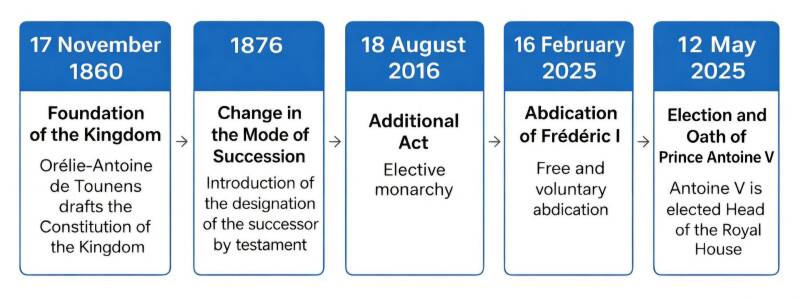
Historical and Constitutional Timeline of the Kingdom of Araucania and Patagonia (1860–2025)